
Measuring Whether Sustainable Farming Makes Households More Resilient
Introduction
A farm can look stronger on paper while the household remains vulnerable. Yields may rise, soil may improve and new techniques may take hold, yet families can still face a poor harvest, volatile prices or an unexpected medical bill. The real test of sustainable farming is not whether a practice was adopted, but whether people can better withstand a shock and recover without sacrificing their future. These sustainable farming outcomes matter because they show whether change benefits households as well as farmland.
This calls for a different way to judge success. Resilience is more than a harvest figure or a snapshot of household income. It is the ability to keep food on the table, protect essential assets and make choices when conditions worsen. Measuring sustainable farming outcomes well means following households through good seasons and bad, and asking what changed, for whom and at what cost.
Analysis of the teams and players
Think of the evaluation as a comparison between two similar groups: households using a defined set of sustainable practices and those continuing with their usual methods. The comparison is meaningful only if both groups face broadly similar conditions. Soil, water access, distance to markets, household size and starting wealth can all affect sustainable farming outcomes before a seed is planted.
The household, not the plot, is the focus. A farm-level study might show a better crop but miss the fact that the family spent more on labour, took on debt or lost income from other work. Researchers should record who controls the harvest and earnings, how work is shared, and whether women and younger household members benefit. A practice that boosts production but shifts risk or unpaid work onto one person is not an unqualified success, even if some sustainable farming outcomes look positive.
Selection can also distort the comparison. Farmers who adopt new methods may already have more land, stronger local networks or better access to information. Comparing them with all non-adopters may exaggerate the intervention’s effect. Baseline surveys, matched comparison households and repeated follow-ups can reduce this bias. Where feasible, phased rollouts or random assignment offer a stronger test of sustainable farming outcomes.
The scorecard should go beyond production. Livelihood indicators should include net farm income, income sources, savings, debt, productive assets and the ability to cover essential expenses. These measures show whether higher output brings greater security or whether the apparent gain disappears once costs and risks are counted. Together, they provide a fuller picture of sustainable farming outcomes.
Key factors
First, measure income stability as well as average income. Two households may earn the same amount in a year but face very different risks: one may have a steady income, while the other gets a high return followed by months of scarcity. Tracking seasonal variation, missed payments, borrowing and asset sales shows how far income can fall before a family is forced into damaging choices. These patterns help explain which sustainable farming outcomes offer lasting security.
Food access matters just as much. Record whether households have enough to eat throughout the year, how varied their diets are, and whether they skip meals or rely on less preferred foods during lean periods. A larger harvest does not guarantee better nutrition if crops are sold to repay debt, prices are poor or families cannot afford other food. Examine results for different household members rather than relying on a single average.
Assess climate adaptation under real pressure rather than inferring it from adoption alone. Drought-tolerant crops and water-saving methods may be promising, but their contribution to resilience is clearer when weather records are considered alongside crop losses, recovery time and coping strategies. Did families maintain production during a dry spell? Did they avoid selling livestock or withdrawing children from school? These outcomes say more about resilience—and sustainable farming outcomes—than a list of adopted practices.
Time and trade-offs matter. Soil improvements may take several seasons to affect yields, while new equipment, seed or training can raise costs right away. An assessment that ends after one harvest may capture the expense before the benefit—or mistake a good-weather windfall for lasting change. Follow households over several seasons, including the costs and time involved in adopting a practice and whether they can continue using it without outside support. This longer view makes sustainable farming outcomes easier to distinguish from temporary gains.
Averages can also hide who benefits. Report outcomes by wealth, gender, land size, location and other relevant factors. If gains go mainly to farmers with irrigation or larger plots, the overall result may overstate what poorer households can achieve. A credible account should show both the median change and the range of results, including households that saw no improvement.
Match scenario
Consider a district where some farmers adopt soil- and water-conservation practices while similar households continue as usual. Before the season, evaluators record income, food security, assets, debt, labour and past crop performance. They then follow the same households through planting, harvest and the lean season, noting weather, input costs, sales and any support received. This design can reveal sustainable farming outcomes across the full agricultural cycle.
Now suppose the rains fail. The key question is not simply which group harvested more. Did participating households lose less, maintain food access, avoid expensive borrowing and return to normal production sooner? If yields held up but debt rose sharply, the result is mixed. If income improved in a good season but collapsed in a dry one, there is not yet enough evidence that household resilience has improved.
Evaluators must also consider what caused the results. Better outcomes may reflect the farming practice, but they could also stem from a new road, a price change or a relief programme. Document these influences and compare trends between groups rather than crediting every improvement to the intervention. The strongest evidence comes when several measures improve together over time: income becomes less volatile, food access strengthens, distress sales decline and households recover faster after a shock.
Conclusion
Good measurement treats resilience as something tested season by season, not a prize for adopting a technique. It follows households as well as crops, accounts for costs and differences in who benefits, and separates promising signs from evidence of lasting improvement. Such evidence helps determine whether sustainable farming outcomes extend beyond the field.
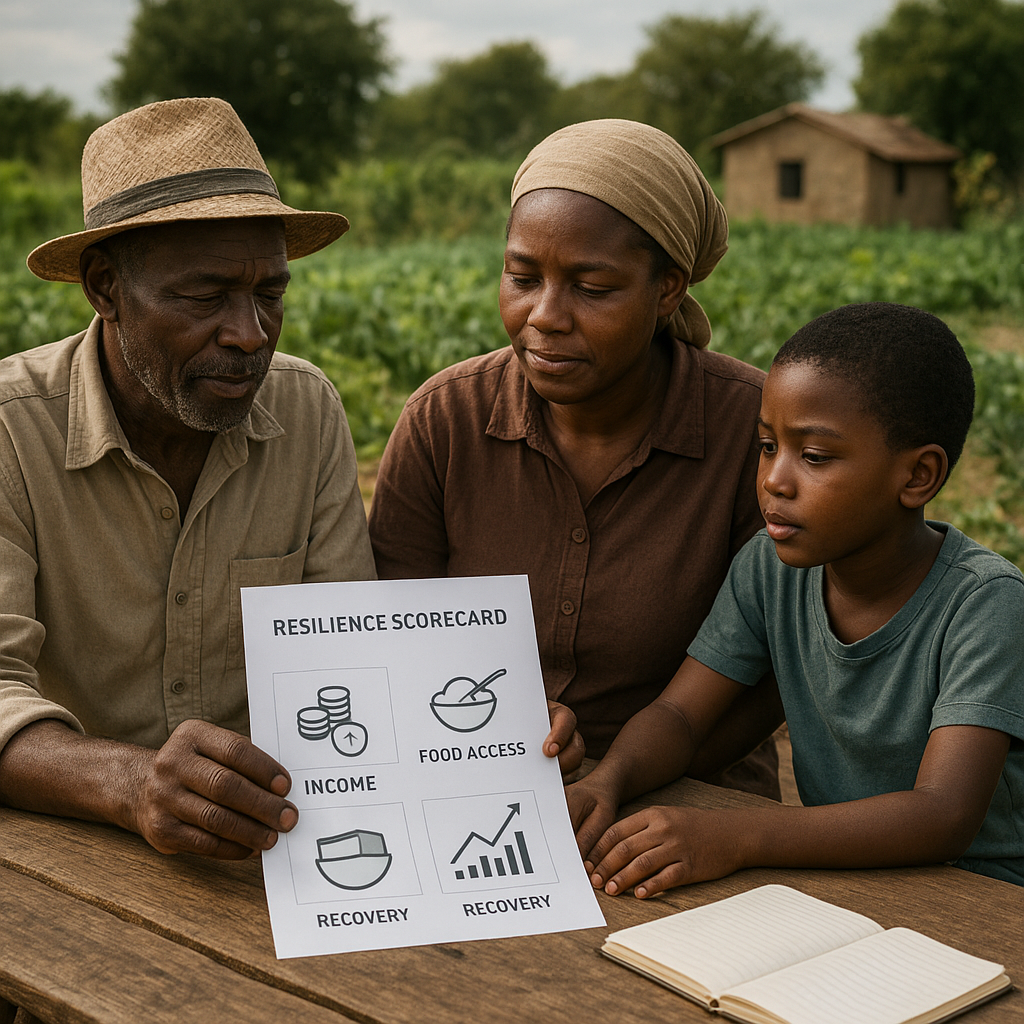
The key question is whether families can absorb uncertainty without giving up the assets, nutrition or opportunities they need for the next season. Sustainable farming matters when it gives them that practical freedom. A practice may still benefit soil or biodiversity, but that alone does not prove household resilience has improved or that sustainable farming outcomes are durable.