
Inclusive Farm Technology: Designing for Women and Older Farmers
Introduction
The best farm tool is not necessarily the most powerful. It is one that people can use safely, repair locally and handle throughout a long working day. That is the real test of inclusive farm technology.
Equipment is often designed for an assumed user: strong, experienced with machinery and able to work at a standard height and grip. But women and older farmers are not exceptions in agriculture. Their needs show whether a design works for real people or only for an imagined average. Inclusive farm technology starts by recognizing that there is no single standard user.
This is about more than comfort. A heavy handle, hard-to-read display or control that requires two hands can affect who operates a machine, takes on a new task or earns from a harvest. On a farm, small design choices can shape access, safety and productivity throughout the season. Inclusive farm technology can help remove these barriers when it reflects farmers’ everyday needs.
Analysis of the teams: users and designers
Think of the design process as a collaboration between two sides. Farmers bring practical knowledge of soil, weather, workloads and maintenance. Manufacturers and researchers bring engineering expertise, materials and production capacity. Good results depend on whether they work together from the start. Inclusive farm technology is more likely to succeed when farmers help shape it early.
When farmers are consulted only after a prototype is finished, their feedback may come too late to change its basic assumptions. The reach, weight, operating speed and service requirements have already been set.
Better design involves women and older farmers from the first sketches through field trials. This means observing how they carry, clean and store equipment, then testing it in different conditions. A tool that works in a showroom but fails in mud, heat or a crowded shed has not passed the real test. This user-led process is central to inclusive farm technology.
Technology also affects power and opportunity. A discussion of farm women’s empowerment, sustainable development and practical innovation helps explain why design cannot be separated from who controls resources and whose expertise is valued.
There is no single user profile. Age, strength, disability, literacy, language and experience vary within every group. Inclusive design does not require one machine for everyone. It means offering adaptable settings and clear choices without making routine tasks feel specialized. Inclusive farm technology should make those choices practical and easy to use.
Key factors
First, equipment must fit its users. Handles should suit different hand sizes, controls should be easy to reach, and tools should not require more force or lifting than necessary. Adjustable working heights and well-balanced designs can reduce strain without sacrificing precision.
Weight is only part of the equation; balance matters too. A light tool can be hard to control if it is poorly balanced, while a support or harness can make a heavier machine easier to manage. Designers should test repeated use, not just whether someone can lift an object once.
Second, equipment should be easy to understand and use. Labels need to be legible in bright light, settings easy to distinguish, and instructions clear of dense text and technical jargon. Controls that give clear feedback help prevent mistakes, especially when users are tired or working in noisy conditions.
Third, new technology must suit its setting. Appropriate technology solves a practical problem and works reliably in local conditions. A digital feature is useful if it supports that goal. If it depends on constant connectivity, expensive servicing or unavailable specialist training, it may become a barrier rather than an advantage. Inclusive farm technology should be selected and adapted with these local realities in mind.
Cost and repairability matter just as much. A machine that saves time but cannot be maintained locally can leave a farmer stranded when it breaks. Durable components, accessible spare parts and straightforward repairs may be as important as performance.
Labor-saving tools can ease repetitive or strenuous work, but their value depends on who controls them and how the saved time is used. If a device is too expensive, assigned to someone else or designed for tasks women do not perform, it will not create greater opportunity. Inclusive farm technology should expand who can benefit from these tools.
Training should be part of the design and delivery, not an afterthought. Demonstrations in familiar languages, hands-on practice and field-ready guides help users operate equipment with confidence. Training should also account for time constraints and avoid assuming that everyone has used machinery before.
Finally, success should be measured by more than sales. Who can operate the equipment independently? Does it reduce pain or injury? Does it make the task more reliable, and can users afford to keep it working? These questions make agricultural access a practical measure of success, not just a slogan. They also help show whether inclusive farm technology is delivering real benefits.
Match scenario: from prototype to working field
Imagine a small farm testing a new planting tool. It places seeds accurately, but its grip forces the operator to bend and squeeze repeatedly. A basic assessment might call it a technical success. Field testing reveals a design that could exclude some users or cause fatigue over a full day.
In the next version, the handle angle is changed, less force is needed to release seeds, and the working height can be adjusted. Farmers test the tool over several sessions, including setup and cleaning. The main improvement is not a flashy feature, but a better fit between the tool and its users.
Now imagine the machine works well, but one of its parts breaks and cannot be replaced locally. Farmers lose time and trust, and a promising innovation goes unused. A repair plan, available parts and clear maintenance instructions are essential to the equipment’s performance.
Inclusive farm technology should be judged over a full season, not by a launch-day demonstration. Good design combines manageable physical demands, clear controls, affordability and repairability. It also allows for local adaptation: tools should suit the conditions of the farm, not force the farm to adapt to them.
Conclusion
Designing for women and older farmers is not simply a matter of making machinery smaller or simpler. It tests whether technology serves the range of people who grow food and reduces barriers without limiting what they can do. Inclusive farm technology makes this broader purpose part of the design process.
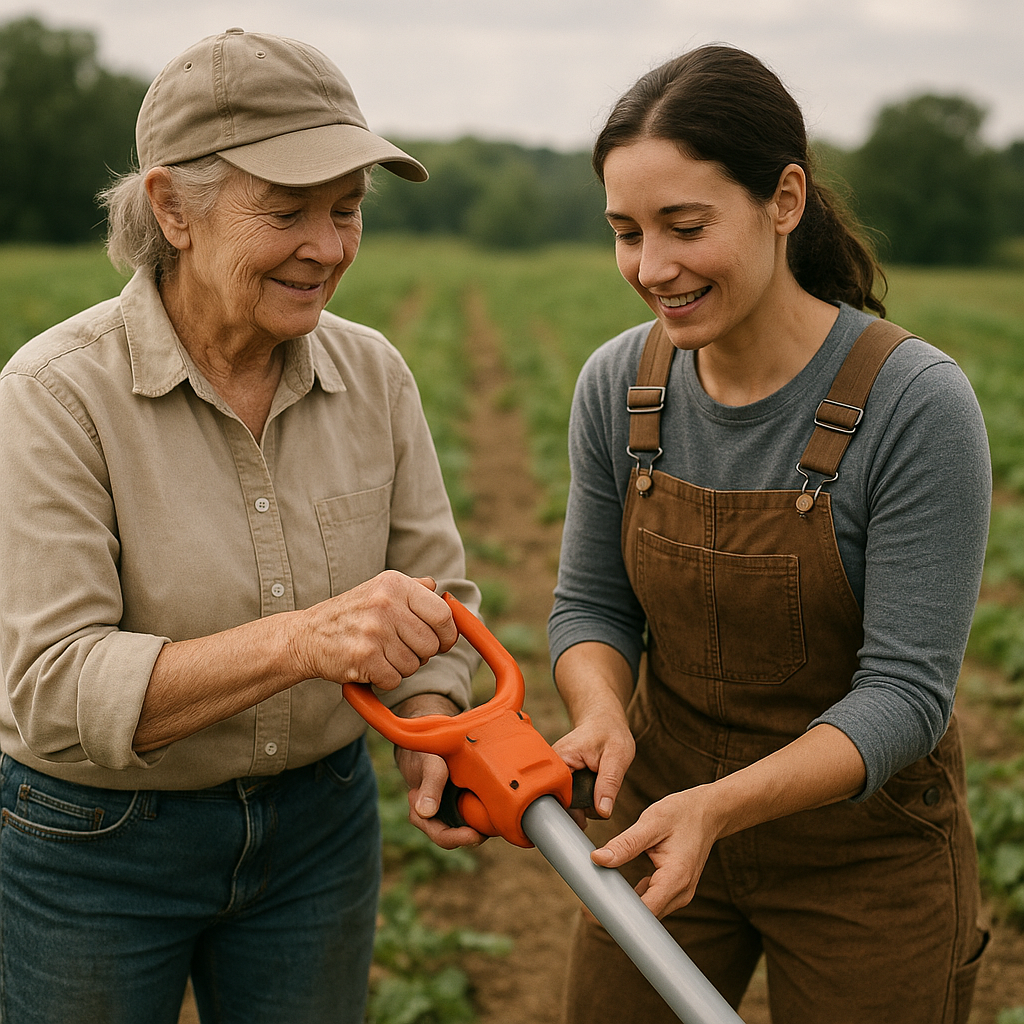
The best approach is collaborative: farmers help define the need, designers respond to evidence, and field testing shows what works. When equipment fits its users, can be maintained and supports meaningful access to agricultural work, inclusive design is no longer a separate category. It is a measure of whether the technology is fit for the job.