
Community Seed Banks: The Local Defence of Food Security
Introduction
Food systems are often judged by what reaches the market: how much is harvested, what it costs and whether supply is reliable. But another question matters just as much: what will people be able to plant next season? When seeds are hard to find, too expensive or poorly suited to local conditions, farmers’ choices narrow before the growing season begins.
Community seed banks help keep those choices open. Managed by local farmers and communities, they collect, store and share local seed varieties that may have little place in commercial supply chains but are valuable in a particular landscape. They cannot replace broader investment in agriculture, but they can reduce dependence on a single supplier or a narrow range of crops.
The comparison with sport goes only so far. A seed bank is not a team chasing a quick win, but it does rely on coordination and preparation. Seeds must be diverse, storage reliable and access governed by rules people trust. If any of these elements fails, the whole effort is at risk.
Analysis of the teams and players
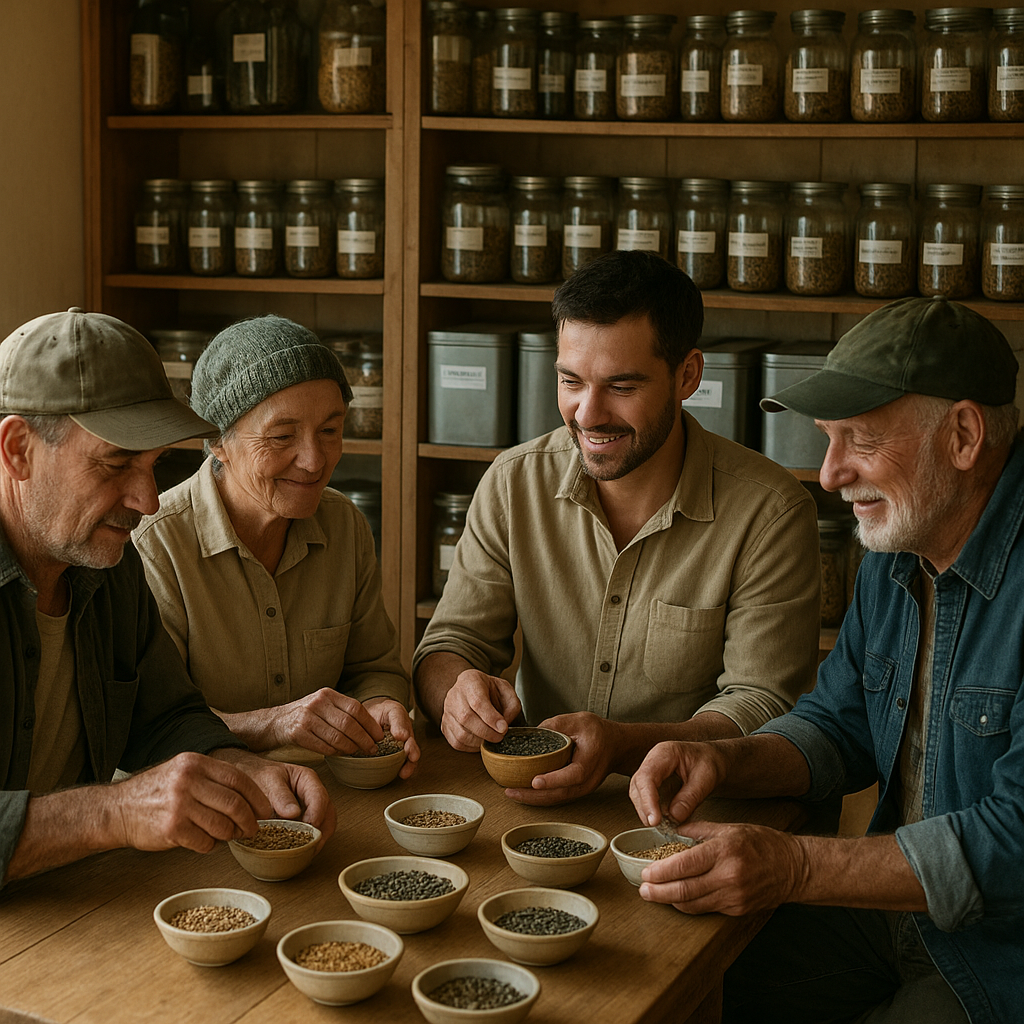
The first and most important participants are the community: farmers, seed keepers, local organisations and, where appropriate, researchers and public agencies. Farmers are not just recipients of a service. Their knowledge helps identify which varieties withstand local pests, suit particular soils, mature at the right time or work well in household cooking. Community seed banks work best when these growers shape priorities and decisions.
Local varieties are more than entries in a catalogue. Many reflect generations of selection and observation, including traits that have never been formally measured. When growers exchange seeds and experience, they help preserve both the varieties and the knowledge needed to grow them. In this way, community seed banks can keep local seed varieties in active use, rather than simply preserving them in storage.
The seed bank is also central, but a storehouse alone cannot ensure continuity. Seeds must be collected with consent, labelled correctly, dried and stored in suitable conditions. Their ability to germinate also needs to be checked and maintained over time. These practices help community seed banks remain reliable sources of planting material.
Governance determines whether a seed bank truly belongs to the community. Clear rules on who can deposit, borrow or receive seeds—and what happens when supplies are limited—build trust. If a small group controls access without accountability, the bank may reinforce the inequalities it was meant to address. Transparent governance helps community seed banks support seed sovereignty and fair access.
Public institutions and scientific partners can help test germination, improve storage, document traits and connect local initiatives with wider networks. Their expertise is most useful when they work alongside communities. A technical system that overlooks local priorities may preserve seeds while weakening the relationships that keep them in use.
Key factors
The first factor is diversity. Growing different species and varieties can spread risk, since crops vary in their growing periods, uses and responses to stress. Diversity cannot guarantee a harvest, but it gives farmers more options when rainfall shifts, pests spread or a crop performs poorly. Community seed banks can contribute to crop diversity by making a wider range of planting material available.
Climate and market shocks rarely happen in isolation. A household that depends on a few crops may be vulnerable to a single failure. A broader mix can provide food, seeds for the next planting and produce to sell. Community seed banks help keep these options available locally and can strengthen farmer resilience when conditions change.
The second factor is access. A bank may hold valuable seeds but do little for food security if farmers cannot afford them, reach the collection point, understand the rules or get enough to plant. Community-designed systems can address these barriers, but must also consider women farmers, younger growers and households with limited land or resources. Community seed banks are most useful when access is practical and inclusive.
Food insecurity depends on more than agricultural production. Income, distribution, affordability and social conditions also play a role. The University of California, Davis, explains this wider context in its overview of food insecurity and sustainable agriculture. Seed access is one part of a larger system, not a standalone solution.
The third factor is renewal. Seeds are living material, not static archive pieces. Each season, growers must plant, select and return viable seeds. This cycle depends on participation and successful harvests, so banks need plans for replenishment, record-keeping and losses. Community seed banks rely on this ongoing work to maintain viable stocks.
Resilience also depends on strong institutions. Farmers are better able to cope when they have reliable relationships, shared knowledge and more than one source of inputs. Weak storage, unclear ownership, inadequate funding or restrictions on saving and exchanging seeds can undermine that resilience. By supporting access to seed and shared learning, community seed banks can contribute to farmer resilience.
Match scenario
The strongest model is a seed bank woven into everyday farming. Farmers contribute valued varieties, help set priorities and can access seeds without unnecessary hurdles. The bank supports exchange and learning, keeps reliable records and stores seeds properly. Outside partners strengthen its technical capacity without taking control. Community seed banks embedded in local practice are more likely to stay useful over time.
In this model, benefits build over time rather than appearing in a single dramatic season. A locally adapted variety remains available, growers learn from one another and the community has more ways to respond when conditions change. Success depends not just on how many samples are stored, but on whether seeds are planted, renewed and shared.
A weaker model is built around a launch, a grant cycle or a showcase. Seeds are collected but not regularly tested, records become unreliable, access is restricted and the bank loses touch with farmers’ changing needs. It may look active on paper while becoming less useful for planting and food security. Community seed banks need sustained participation, not just a one-time investment.
A poor harvest creates another challenge: there may be few seeds to return just as demand for stored stocks rises. A well-prepared bank plans for this with transparent allocation, multiple sources of seed and practical agreements with partner groups. It cannot eliminate scarcity, but it can help the community make decisions together and preserve options for recovery.
Conclusion
Community seed banks are not simply warehouses. They are locally governed systems that keep agricultural options in circulation. Their contribution to food security depends on crop diversity, reliable stewardship, fair access and farmers’ knowledge—not storage alone.
Their value becomes clear over time. When communities can conserve and exchange local varieties, they strengthen seed sovereignty and gain room to adapt without relying entirely on external suppliers. This is no guarantee against every shock, but it gives communities more resources to draw on when one arrives.