
Accessible Irrigation for Communities Facing Unpredictable Rainfall
Introduction
For communities that rely on rain-fed farming, a late rainy season means more than an uncertain forecast. It can delay planting, stress crops and leave little time to recover. As rainfall becomes less reliable, irrigation gives farmers more control over when they can water their fields. Small-scale irrigation can provide that flexibility without requiring every farm to have its own large water system.
This does not require a large dam or an expensive network of pipes. Small-scale irrigation can be as simple as a shared pond with gravity-fed channels or a pump serving a few plots. The challenge is to choose a system that fits local water supplies, household budgets and the crops people grow—and to keep it working beyond a single dry spell. Good community water management helps ensure that limited supplies are shared fairly.
Analysis of the options: the contenders
No single technology works best everywhere. Each has advantages and drawbacks, and the most effective approach is often a combination of methods. Small-scale irrigation systems can combine these options to suit local conditions.
Water harvesting can provide a first line of defence where runoff can be safely collected. Roofs, farm ponds, small reservoirs and contour structures capture water during wet periods for later use. These options can be relatively affordable, but they depend on suitable sites, enough storage and regular maintenance to prevent leaks, sediment buildup and contamination. Pairing water harvesting with small-scale irrigation can help make stored water available when crops need it.
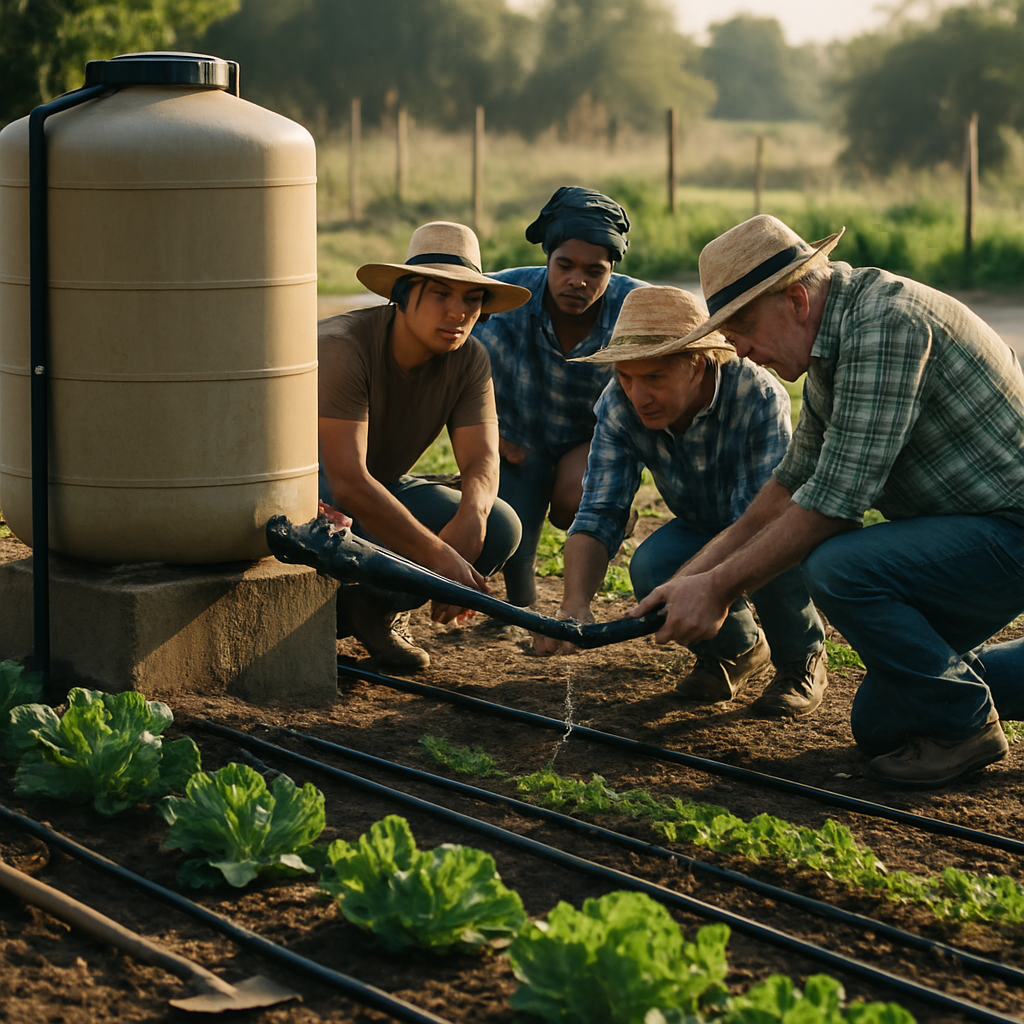
Gravity-fed irrigation works well when a spring, elevated tank or pond sits above the fields. It avoids fuel costs and can deliver water through simple channels or low-pressure pipes. But it cannot overcome the terrain: flat or uphill fields may need another method, and poorly designed channels can waste water. For suitable sites, gravity-fed small-scale irrigation offers a straightforward way to move water to crops.
Drip irrigation delivers water close to plant roots, helping limited supplies go further, especially for vegetables and other high-value crops. It requires clean water, working emitters and access to replacement parts. Clogged filters or repairs that require outside expertise can make an otherwise efficient system costly to maintain. In a well-maintained small-scale irrigation setup, drip lines can reduce losses while targeting water where it is needed.
Pumps are useful when water must be lifted from a well, river or pond. Manual pumps reduce reliance on fuel, while solar pumps can lower operating costs if the initial investment and maintenance are manageable. But pumping must be limited: groundwater can run low, and competition over a shared source can lead to conflict. Small-scale irrigation using pumps needs clear limits to protect shared water sources.
For many households, irrigation works best as a supplement to rainfall. A modest system that protects seedlings or carries crops through a critical dry spell may be more practical than infrastructure designed to water every field all season. This kind of small-scale irrigation can complement rainfall rather than replace it.
Key factors: what decides the contest
Start by asking how much water is reliably available, not which pump to buy. Communities need to understand seasonal flows, storage capacity, groundwater levels and competing needs, including drinking water, livestock and ecosystems. A plan based on overly optimistic estimates may fail during the longest dry spell. Small-scale irrigation should be planned around realistic water availability.
Consider costs over the system’s lifetime. The purchase price is only part of the total; energy, repairs, spare parts, transport and labour also matter. Shared infrastructure can spread costs, provided users agree on contributions and have a transparent way to fund maintenance.
Crop choice also matters. Watering crops at vulnerable growth stages can protect productivity, but water-intensive crops may exceed a small system’s capacity. Matching crops and planting schedules to available water can be just as important as improving delivery efficiency.
Access is another key concern. A technically sound system can still exclude farmers who cannot afford a connection, live far from the source or have little influence over local decisions. Fair rules for water turns, fees and emergency access help ensure that the benefits reach more than the best-connected households.
Local repair skills are essential, too. Simple equipment that can be maintained nearby may be more reliable than a sophisticated system that depends on distant technicians. Training operators, stocking common parts and assigning responsibility for routine checks are all part of good irrigation planning.
Match scenario: a dry spell in mid-season
Imagine a community that collects runoff in a shared pond during the early rains. The rains then pause just as young crops need water. Households follow a clear rotation: gravity-fed lines serve lower plots, while a pump lifts water to fields the pond cannot reach on its own.
The system works not because one technology does everything, but because the different parts are coordinated. Farmers prioritise vulnerable crops, water plants near their roots where practical and avoid using the pond for lower-priority needs. Local managers track withdrawals and adjust turns as supplies change.
Without clear rules, the system can quickly run into trouble. Households with stronger pumps may take more than their share, a clogged filter can stop delivery, and falling water levels may reveal that the plan assumed more rainfall than arrived. Monitoring, agreed limits and a repair fund help the community respond before a shortfall becomes a crisis.
Irrigation cannot guarantee every harvest. But when it is appropriately sized, uses a sustainable water source and is managed with trust, it can reduce reliance on a single window of rainfall.
Conclusion
Accessible irrigation is less about finding the perfect machine and more about building a reliable local system. Water harvesting, storage, efficient delivery and responsible pumping can all help, but each depends on available water, affordability and shared rules.
For communities facing unpredictable rainfall, a sound strategy starts small: assess local water supplies, choose equipment people can maintain and agree on fair limits before scarcity fuels competition. This helps small-scale irrigation support crop productivity without worsening water shortages.